






When enterprises invest in digital signage, great content is only half the equation. The other half—often overlooked—is screen placement. Where you position screens determines whether your content is easily seen, understood, and acted upon. Getting placement right means grounding decisions in behavioral patterns, environmental conditions, and the purpose of each screen.
Before thinking about where to put your screens, make sure your digital signage strategy for enterprise is solid. Placement decisions are only effective when tied to a larger business goal and audience plan.
Below are the digital signage screen placement best practices that help large organizations maximize visibility and impact across every location.
Why Screen Placement Matters More Than Most Enterprises Realize
In many enterprise deployments, organizations invest heavily in content strategy, hardware, and CMS capabilities—but overlook the physical placement of screens. The result is predictable: great content delivered in the wrong place at the wrong moment.
Poor screen placement leads to:
- Low visibility
- Reduced dwell time
- Missed calls-to-action
- Wasted investment
VP of Product Insight
“Screen placement is one of the most underestimated drivers of digital signage performance. Content only works when people can actually see it, pause long enough to absorb it, and encounter it at the right moment in their journey.”
Christian Armstrong, Vice President of Product Management
1. Start With the Customer Journey (Not the Floor Plan)
Digital signage shouldn’t be placed where you have space—it should be placed where people naturally look, pause, or make decisions.
Key moments to analyze include:
- Entry paths
- Decision points (menus, service counters, product aisles)
- High dwell areas (waiting rooms, queues, lounges)
- Transitional zones (hallways, walkways)
Before installing anything, walk the space the way your customers do. Where do they slow down? Where do they need guidance? Where do they get stuck?
Screens should live where attention already exists—not where you hope it will.
2. Match Screen Size and Height to Viewing Distance
Visibility is the foundation of effective signage. If people can’t easily read your content, it fails—no matter how good the message is.
Best practices include:
- Larger screens for long viewing distances
- Smaller screens only when viewers are close (e.g., kiosks or check-in counters)
- Eye-level placement for content requiring engagement or reading
- Above-eye level placement for passive content in busy common areas
A simple rule:
The farther away your viewer is, the fewer details your content should contain.
3. Prioritize High-Dwell Areas for Information-Rich Content
Not all screen locations are equal. Areas where people naturally pause are ideal for more detailed content such as:
- Product education
- Queue messaging
- Employee communications
- Offers or promotions requiring more reading time
Examples of high-dwell spaces:
- Service queues
- Waiting rooms
- Elevator lobbies
Conversely, fast-moving areas require simple, bold, high-contrast messaging.
4. Avoid Common Visibility Killers
Even well-intended installations fail if environmental factors interfere with visibility.
Watch out for:
- Glare from windows or overhead lights
- Obstructions such as décor, columns, or hanging signage
- Screens mounted too high or too low
- Poor contrast against background walls
Controlling for these factors ensures the message remains clear, sharp, and readable.
5. Use Screens to Reduce Congestion and Improve Flow
Digital signage isn’t just for marketing—it’s also a navigation tool.
Thoughtful screen placement can:
- Reduce line anxiety with queue information
- Redirect visitors more efficiently
- Shorten perceived wait times
- Provide real-time instructions or updates
When screens shape movement, the entire environment feels more organized and intuitive.
6. Align Screen Purpose With Location
Every screen should have a job—and the location should support that job.
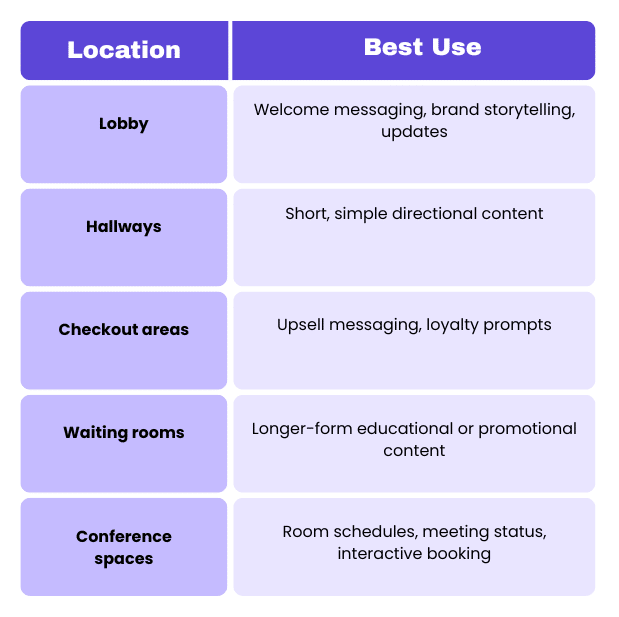
If a screen’s purpose and location are mismatched, effectiveness drops instantly..
7. Test and Iterate With Real Traffic Patterns
Even the best placement plan is still a hypothesis until tested.
Enterprise teams see the best results when they:
- Review camera or traffic data
- Conduct A/B tests of screen locations
- Ask front-line staff where customers look or get confused
- Adjust angles, heights, or placements after observing real behavior
Optimizing placement is an ongoing process—not a one-time decision..
Final Takeaway
Digital signage screen placement isn’t an art—it’s a science grounded in how people move, look, and engage in physical spaces. By following digital signage screen placement best practices, enterprises can improve visibility, strengthen brand impact, guide customers more effectively, and significantly increase the value of their signage investment.
If you want to refine your screen placement strategy—or build a smarter, more effective digital signage ecosystem—Spectrio can help.
Recommended Resource
👉 Download the gated guide: Is In-Store Retail Media Network Right for Me? Learn how enterprise organizations can optimize in-store digital engagement, including screen placement strategies, content planning, and audience measurement.